You may also like

JawForge™ Progressive Resistance System
- Isometric hold protocol — no chewing, no jaw fatigue
- Full-arch design — load distributed, not concentrated on 2 teeth
- 60-Day Visible Definition Guarantee, full refund
not chewed
full-arch load
trigger
silicone
money back
You can hit every macro, log every rep, and still watch your jaw disappear into your neck on camera.
Chewing fatigues your jaw. Holding builds it.
Every other jaw tool on the market — gum, rubber balls, mastic — asks you to repeat the same low-load chewing motion hundreds of times per session. That's isotonic movement: high repetition, low intensity, and it's exactly why your jaw gets tired without your masseter ever getting bigger.
JawForge works the opposite way. You bite down on a molar block calibrated to a specific resistance level, then hold that contraction — no grinding, no repetitive motion. It's the same isometric principle behind a wall-sit or a weighted plank: a static, sustained load is what actually signals a muscle to adapt and grow, applied here to the one muscle group nobody trains.
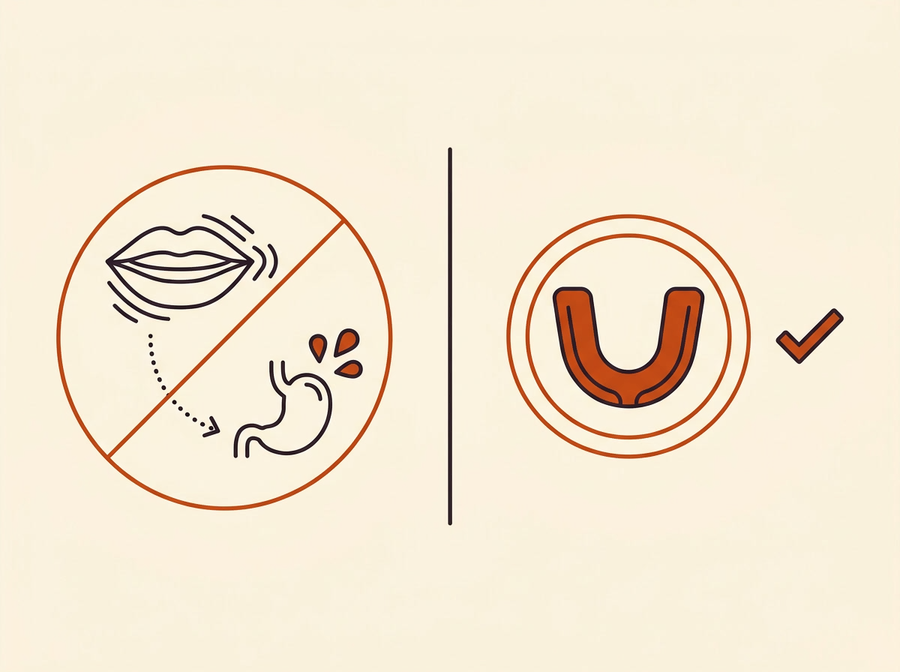
Your body doesn't know the difference between gum and food.
Continuous chewing is one of the strongest triggers of what's known as the cephalic phase response — your body priming itself for digestion before food ever arrives. Saliva output rises, and your stomach begins preparing gastric secretions in anticipation of a meal that never comes. It's a big part of why long gum-chewing sessions leave people bloated, gassy, or oddly hungry rather than satisfied.
A static isometric hold doesn't send that signal the way sustained chewing does. JawForge was built to train the muscle without asking your digestive system to gear up for a meal that isn't coming — so a 10-minute session is jaw training, full stop, not a snack your stomach has to talk itself down from.
Three ways to train your jaw. Only one avoids all three failure points.
| JawForge | Front-Biting Balls | Chewing Gum | |
|---|---|---|---|
| Movement pattern | Isometric hold | Repetitive biting | Continuous chewing |
| Force placement | Distributed across full arch | Concentrated on 2 front teeth | Whole mouth, uneven |
| Digestive response | None — no chewing motion | Minimal | Cephalic priming response |
| Load control | 3 fixed calibration levels | Single, uncontrolled hardness | Softens within minutes |
| Durability | 1-year zero-tearing warranty | Reported tearing in 1–2 weeks | Loses hardness within days |
Calibrated resistance, not a guessing game
A small rubber jaw ball puts effectively all of your bite force through two front teeth, with no way to control how hard you're actually biting — which is exactly why users report front-tooth soreness and jaw popping. JawForge's full-arch shape spreads that same bite force across your entire jawline instead of concentrating it on a single point.
Pair that with three fixed resistance levels — engineered to specific, tested poundage rather than "however hard you can bite" — and you get a controlled, progressive training curve instead of a single mystery-hardness piece you either can or can't get through.
Three resistance levels. One 60-day protocol.
Muscle only grows when the load increases. Like any progressive-overload program, you start light, hold longer, and move up a level as each becomes comfortable.
$0.98 a day vs. $8–$10 a day for a temporary fix.
Nothing to lose. Not your jaw, not your teeth, not your money.
Before you start training
Why is this an isometric hold instead of chewing?
Why does it matter that this doesn't trigger a digestive response?
Will this damage my TMJ joint or shift my teeth?
Isn't jaw shape completely genetic?
Will this make a woman's face look bulky or overly square?
How long until I see results?
Ten minutes a day. No chewing. No compromise.
Start with the Complete Transformation System — three resistance levels, the full 60-day protocol, and a guarantee that puts the risk on us, not you.
Shop JawForge — €52,95